
Buying a pre-owned boat can be a smart way to get more features for your budget, but the search requires careful attention to condition, history, and pricing. Listings for used boats for sale can range from lightly used vessels to older boats that need significant repairs. Offshore Yacht Group can be a useful resource for buyers comparing available vessels and narrowing down options based on their boating plans.
The first decision should be based on how you intend to use the boat. A center console may suit fishing and coastal cruising, while a cabin cruiser offers more space for overnight trips. Bowriders work well for day trips and family recreation, while larger yachts are designed for extended cruising and entertaining.
Knowing your intended use helps eliminate boats that look attractive in an online listing but do not match your actual needs. Consider the number of passengers, typical cruising distance, storage requirements, preferred waterways, and the amount of maintenance you are prepared to handle.
Research the Boat Before Seeing It
A boat’s listing provides only part of the picture. Before arranging an inspection, gather as much information as possible about the vessel. Ask for the year, make, model, engine type, engine hours, maintenance records, ownership history, and any known repairs.
Pay close attention to service documentation. Regular oil changes, scheduled engine maintenance, winterization records, and repairs completed by qualified technicians can provide useful evidence of how the boat has been cared for.
The boat’s age should not be the only consideration. An older vessel with consistent maintenance may be a better purchase than a newer boat that has been neglected. A well-documented history gives buyers more confidence and makes it easier to estimate future maintenance costs.
Inspect the Hull and Deck Carefully
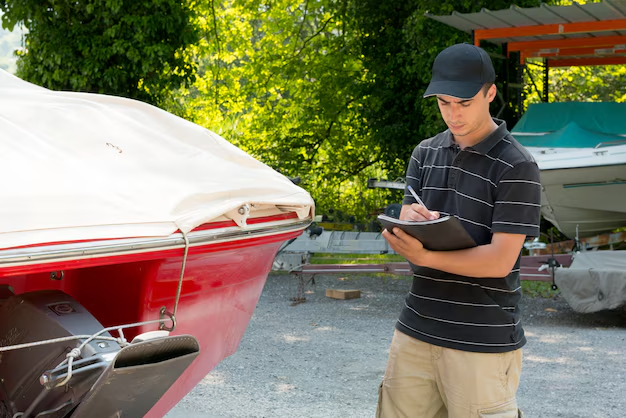
The hull deserves close attention because structural repairs can become expensive. Look for cracks, blisters, damaged gelcoat, unusual patches, or areas that appear different from the surrounding surface. On fiberglass boats, inspect carefully for signs of impact or water intrusion.
The deck should also feel solid underfoot. Soft or spongy sections may indicate water damage or problems with the underlying core. Check hatches, storage compartments, railings, cleats, swim platforms, and other fittings for corrosion, looseness, or damage.
A boat that looks clean in photographs may reveal very different conditions during an in-person inspection. Take your time and inspect areas that are easy to overlook, particularly spaces around fittings and below deck.
Give the Engine Extra Attention
The engine is one of the most expensive components on many boats, so its condition should have a major influence on the buying decision. Ask to see the engine when it is cold rather than inspecting only after it has been warmed up.
Look for oil leaks, corrosion, damaged hoses, loose connections, unusual odors, and signs of poor maintenance. Check the engine hours and compare them with the boat’s age and stated usage.
A professional marine mechanic should perform a mechanical inspection before money changes hands. The inspection can identify problems that are not obvious to a buyer, including compression issues, cooling-system problems, electrical faults, or worn components.
For boats with outboard engines, inspect the lower unit, propeller, steering system, mounting area, and hydraulic components. Inboard and sterndrive systems require attention to additional mechanical and cooling components.
Do Not Skip the Sea Trial
A sea trial provides information that a dockside inspection cannot. During the trial, pay attention to how quickly the boat starts, how smoothly the engine runs, and how the vessel handles at different speeds.
Test steering, acceleration, reverse operation, trim systems, electronics, navigation equipment, bilge pumps, lights, gauges, and other onboard systems. Listen for unusual sounds or vibrations and watch for excessive smoke from the engine.
The boat should perform consistently rather than simply running well for a few minutes. A seller who refuses a reasonable sea trial or mechanical inspection should be treated cautiously.
Compare the Asking Price With the Real Cost
An attractive purchase price does not necessarily mean the boat is inexpensive. Buyers should calculate the total cost of ownership before making an offer.
Along with the purchase price, account for insurance, registration, storage, marina fees, fuel, routine maintenance, repairs, safety equipment, and potential upgrades. Older boats may also require replacement of items such as batteries, canvas, electronics, pumps, hoses, or upholstery.
Compare similar boats by looking at their age, model, engine hours, equipment, maintenance history, and overall condition. Two vessels with the same year and model can have very different values because of how they were used and maintained.
A lower-priced boat that needs extensive repairs can quickly cost more than a well-maintained vessel with a higher initial asking price.
Check Ownership and Documentation
Proper paperwork protects buyers from unnecessary complications after the purchase. Verify the hull identification number and make sure it matches the documentation and registration records.
Ask for maintenance invoices, manuals, warranty information where applicable, registration documents, and records related to major repairs or upgrades. Buyers should also check for outstanding liens or other ownership issues according to the requirements in their jurisdiction.
Documentation can reveal useful details about the boat’s past. Major repairs, engine replacements, electrical upgrades, and other work should be documented whenever possible.
For a higher-value boat, professional assistance with documentation and the purchase process can be worthwhile.
Consider the Boat’s Equipment
Equipment can significantly affect a boat’s value. Navigation systems, radar, fish finders, autopilot systems, generators, air conditioning, upgraded sound systems, trailers, and other accessories may add considerable value when they are in good working condition.
Do not assume every accessory listed by the seller is fully operational. Test the equipment during the inspection or sea trial and ask about its age.
Older electronics may appear impressive on a specification sheet but could be difficult or expensive to replace. Consider the condition and remaining useful life of each major component rather than simply counting the number of features.
See also: 3 Cosmetic Dentistry Treatments Ideal For Busy Parents
Make a Careful Offer
Once the inspection and sea trial are complete, use the information gathered to determine a reasonable offer. Repairs that are required should be considered during negotiations, particularly when they affect safety or major mechanical systems.
Avoid making an offer based solely on how much the seller has reduced the original asking price. The relevant question is whether the vessel’s condition, equipment, history, and market value support the proposed price.
It is also wise to keep some money aside for immediate maintenance after purchase. Even a well-maintained used boat may need routine servicing, cleaning, safety equipment, or small repairs before its first major outing.
Choose Condition Over Appearance
A polished exterior can make an older boat look remarkably appealing, but cosmetics should never outweigh mechanical and structural condition. Fresh upholstery, new graphics, and detailed interiors can improve presentation without addressing underlying problems.
Look beyond the surface. Service records, engine condition, hull integrity, electrical systems, and evidence of regular maintenance provide a much clearer picture of the boat’s actual value.
The best purchase is often the vessel that has been consistently cared for, even if it does not have the newest styling or the longest list of accessories.
Make the Purchase With Confidence
Finding a reliable used boat takes more than comparing photographs and prices. Research the model, review its history, inspect the hull and mechanical systems, arrange a professional inspection, and complete a sea trial before committing to the purchase.
A careful process can help buyers avoid expensive surprises and find a vessel that fits both their boating plans and their budget. Take time to compare available options, ask detailed questions, and consider long-term ownership costs alongside the initial price. For assistance reviewing available boats and finding an option suited to your needs, contact us today and discuss your requirements with the team at Offshore Yacht Group.