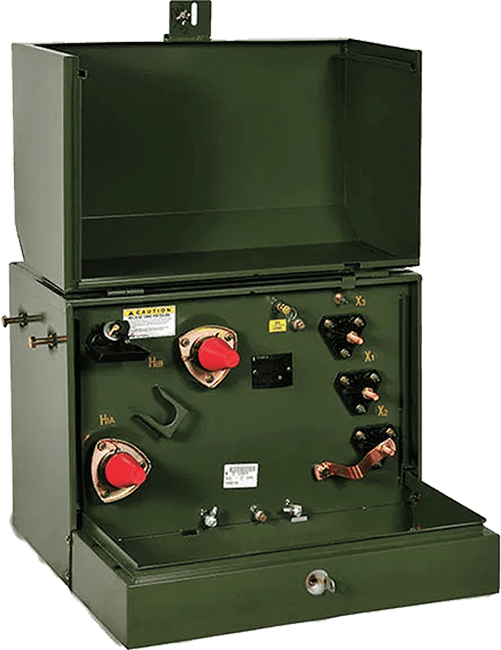

Electrical equipment does not always need a large transformer to receive a stable power supply. Small commercial buildings, workshops, agricultural facilities, residential projects, and light industrial units often operate with moderate electrical loads. For these applications, a 25 kva transformer can provide an appropriate balance between available capacity and equipment requirements.
Selecting the correct transformer starts with understanding the electrical demand of the site. The transformer must accommodate the expected load while also considering voltage levels, phase requirements, operating conditions, and possible future expansion.
What Does 25 KVA Represent?
KVA stands for kilovolt-amperes and describes the apparent power rating of a transformer. A 25 kva transformer is rated to handle 25 KVA of apparent power under its specified operating conditions.
The equivalent usable power in kilowatts depends on the power factor of the connected load. For instance, at a power factor of 0.8:
25 KVA × 0.8 = 20 kW
At a power factor of 0.9:
25 KVA × 0.9 = 22.5 kW
The actual operating capacity depends on factors such as transformer design, ambient temperature, cooling, insulation, and loading conditions.
Starting With the Electrical Load
Transformer selection begins with an assessment of the electrical demand. Simply adding the wattage printed on every piece of equipment may not provide an accurate picture of the required transformer capacity.
Electrical engineers may consider connected load, maximum demand, power factor, diversity, motor starting currents, and operating schedules.
For example, a small workshop might have lighting, ventilation equipment, welding machines, compressors, and several motors. These devices may not all operate at maximum capacity at the same time. The resulting demand could therefore differ considerably from the combined nameplate ratings.
Future requirements also deserve consideration. If additional machines or electrical equipment are planned, selecting a transformer with some additional capacity can prevent an early replacement.
Where a 25 KVA Transformer Fits
A 25 kva transformer is commonly considered for installations with relatively modest power requirements.
Typical applications include:
- Small workshops
- Retail stores
- Offices
- Agricultural facilities
- Residential developments
- Small manufacturing units
- Schools and other small institutions
- Water pumping systems
- Communication facilities
- Temporary construction power
The appropriate transformer configuration depends on the electrical system and the equipment being supplied. A project requiring three-phase power will have different requirements from one using a single-phase distribution system.
Voltage Configuration Matters
KVA capacity alone does not define a transformer. The primary and secondary voltage ratings must also match the electrical system.
The primary side receives power from the incoming supply, while the secondary side provides the required voltage to downstream equipment. A mismatch between the transformer voltage and the site’s electrical requirements can create operational and safety problems.
A transformer specification may include:
- Primary voltage
- Secondary voltage
- Frequency
- Number of phases
- Vector group
- Impedance
- Tap settings
- Insulation class
- Cooling arrangement
The required voltage configuration should therefore be established before purchasing the equipment.
Dry-Type or Oil-Filled?
Transformers are available in several construction types. Dry-type and oil-filled designs are two common options.
A dry-type 25 kva transformer uses solid insulation rather than insulating liquid. This construction is frequently considered for indoor installations, commercial buildings, and applications where oil-filled equipment is not suitable.
Oil-filled transformers use insulating oil for electrical insulation and heat transfer. They are commonly used in outdoor distribution applications and other installations where this type of construction is appropriate.
The selection depends on the installation environment, available space, fire-safety requirements, maintenance arrangements, and project specifications.
Efficiency and Operating Costs
A transformer consumes some energy through electrical losses during operation. These losses are generally divided into no-load losses and load losses.
No-load losses occur while the transformer is energized, even when the connected equipment is using little power. Load losses increase as the electrical load increases.
For a facility where the transformer remains energized throughout the day, efficiency can affect long-term operating expenses. Comparing loss figures between available transformer models can therefore be useful before making a purchase.
The operating load also matters. A transformer that is consistently overloaded may experience excessive heating, while a significantly oversized unit may spend much of its operating life at very low loading.
Installation Requirements
The installation environment has a direct effect on transformer performance and service life.
A 25 kva transformer should have sufficient space around it for ventilation, inspection, maintenance, and safe electrical clearances. Outdoor units may require protection from weather, unauthorized access, physical damage, and water accumulation.
Indoor installations need suitable ventilation because transformers produce heat during normal operation. The installation should also provide appropriate cable routing and access for maintenance personnel.
Grounding is another fundamental requirement. The transformer enclosure and relevant electrical components should be grounded according to applicable electrical standards and the project’s electrical design.
Protection and Safety
A transformer forms part of a larger electrical distribution system and therefore requires suitable protective equipment.
Depending on the application, protection may include circuit breakers, fuses, surge protection, temperature monitoring, and other electrical protection devices.
The protection system should be selected according to the transformer’s ratings and the characteristics of the connected load. Motors and other equipment with high starting currents may require particular attention during system design.
Proper installation is equally important. Connections should be correctly tightened, cables should be appropriately sized, and clearances should meet the applicable requirements.
Maintenance of a 25 KVA Transformer
Routine inspection can help identify developing electrical or mechanical problems before they result in equipment failure.
For oil-filled units, maintenance may involve checking oil levels, inspecting for leaks, examining bushings and terminals, and assessing the condition of the insulating oil where required.
Dry-type transformers can be inspected for dust accumulation, loose connections, insulation damage, and blocked ventilation openings.
Thermal inspection can also identify unusual heating at terminals or connections. Any abnormal temperature pattern should be investigated by qualified personnel.
The manufacturer’s maintenance recommendations should form the basis of the service schedule.
Selecting a Supplier
Technical specifications should be established before comparing suppliers or prices. A suitable supplier should provide documentation covering the transformer’s electrical ratings, efficiency, losses, dimensions, weight, insulation system, impedance, testing, and applicable standards.
Factory testing can help verify that the manufactured unit meets the specified requirements. Buyers may also want to review warranty terms, delivery schedules, spare-parts availability, installation support, and after-sales service.
The transformer should be selected according to the actual requirements of the electrical installation rather than simply choosing the lowest purchase price.
Matching Capacity With Real Demand
A 25 kva transformer can serve a wide range of smaller electrical installations, but its suitability depends on the site’s actual load profile. A proper assessment should account for present demand, equipment characteristics, power factor, starting currents, and planned expansion.
The right transformer is one that provides adequate capacity without creating unnecessary cost or operational limitations. Careful load assessment, correct voltage selection, appropriate protection, and regular maintenance all contribute to reliable power distribution.
For smaller facilities, getting these details right at the specification stage can prevent avoidable electrical problems later and provide a dependable supply for the equipment connected to the system.