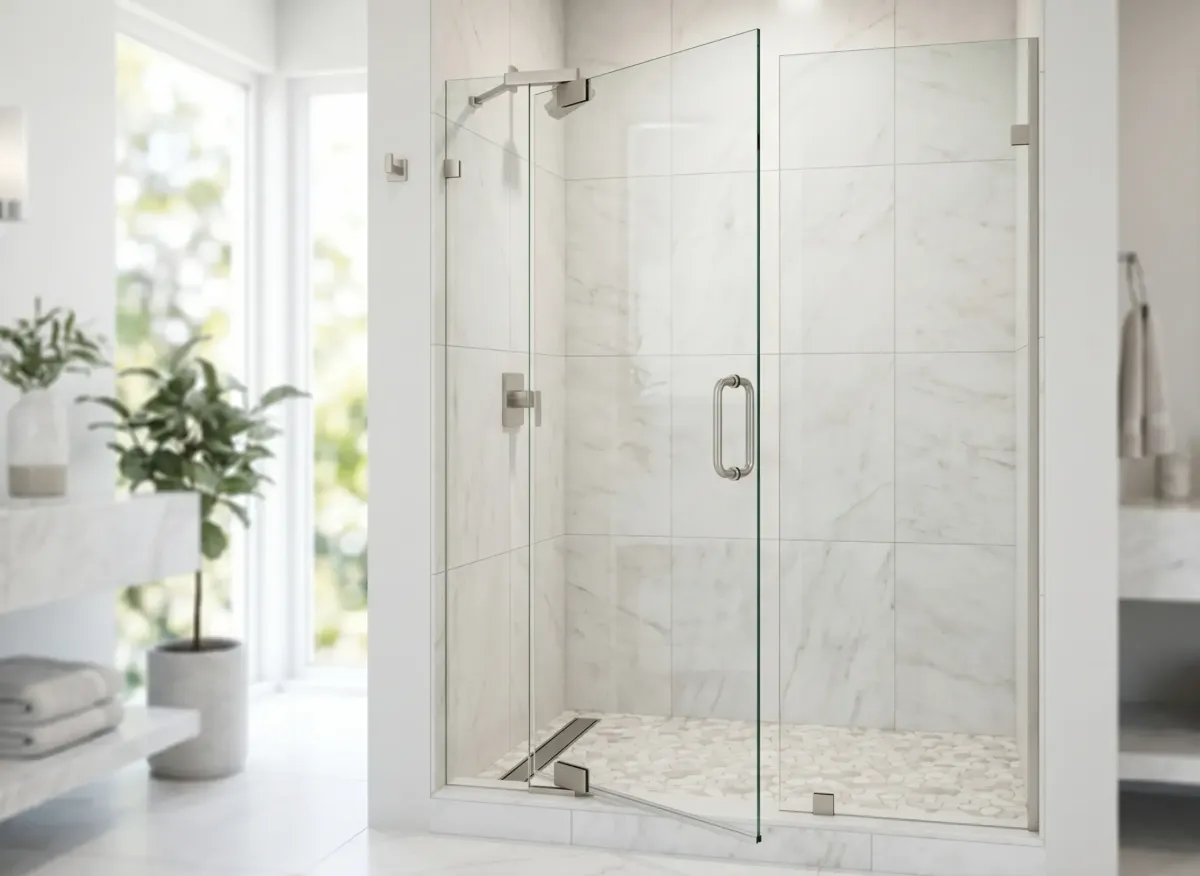

The shower area has become an important part of bathroom planning. It needs to handle everyday moisture and water while fitting comfortably into the available space. At the same time, the enclosure can have a noticeable effect on the overall appearance of the room.
Modern bathroom shower enclosures offer plenty of ways to balance these requirements. Clear glass, minimal framing, practical door configurations, and carefully selected hardware can create an enclosure that feels open without sacrificing everyday function.
The right design depends on the bathroom’s dimensions, shower layout, plumbing, style, and how the space will be used.
Creating a More Open Bathroom
A shower enclosure can visually divide a bathroom into separate sections. Solid walls and heavy framing may make the shower feel like a separate room within the room.
Glass provides a way to create separation without completely blocking the view.
Clear glass allows light to travel through the shower area and keeps surrounding finishes visible. This can be particularly useful in smaller bathrooms where maintaining an open sightline can make the room feel less restricted.
In larger bathrooms, the same approach can help create a simple transition between the shower and the rest of the space.
Choosing the Right Glass
Glass is one of the most visible elements of a shower enclosure, so its appearance and performance both deserve attention.
Clear glass is popular for contemporary bathrooms because it provides maximum visibility. Frosted, patterned, and textured options can provide additional privacy while still allowing natural or artificial light to pass through.
Safety is also essential. Shower enclosures commonly use tempered safety glass designed for use in wet environments. The appropriate glass thickness depends on the dimensions and configuration of the enclosure, along with the hardware and installation method.
The glass should be specified according to the complete system rather than selected as an independent component.
Frameless, Framed, or Semi-Frameless?
The amount of visible framing can significantly influence the character of the bathroom.
A frameless enclosure uses minimal metal framing and relies on suitable glass and specialised hardware. It can create a clean appearance and keep the focus on the shower’s interior finishes.
Framed systems use metal profiles around the glass and can provide a more defined visual structure. They may also suit certain installation conditions where additional framing is useful.
Semi-frameless designs combine elements of both. The choice depends on the bathroom’s style, glass dimensions, structural requirements, and budget.
There is no single configuration that works for every shower.
Selecting a Door That Fits the Layout
Door operation needs to be considered alongside the bathroom’s available floor space.
A hinged shower door requires sufficient clearance to open. Nearby toilets, vanities, walls, towel rails, and other fixtures can affect where the door can move.
Sliding doors can be useful where swing clearance is limited. Pivot doors provide another configuration for certain layouts, while fixed glass panels can be suitable for open shower designs.
The door should be selected after considering the finished bathroom layout rather than relying solely on standard dimensions.
Hardware Can Support the Overall Design
Hinges, handles, brackets, and other hardware may be small, but they remain visible against the glass.
Hardware finishes can be coordinated with faucets, shower controls, cabinet handles, towel bars, and other bathroom fixtures. Chrome, brushed metal, matte black, and other finishes can each produce a different appearance.
The hardware also has an important functional role. Hinges must support the door correctly, while brackets and clips need to be suitable for the selected glass and installation conditions.
Good hardware selection therefore involves both appearance and compatibility.
Managing Water Inside the Shower
An attractive enclosure still needs to perform its basic job: keeping most shower water within the intended area.
The position of the showerhead can influence this significantly. Water directed toward a door opening or exposed gap is more likely to escape.
Door seals and sweeps can help control water around moving panels. Fixed glass panels can also be positioned to block spray while maintaining an open entrance.
The floor or shower tray must provide suitable drainage, and surrounding surfaces need appropriate waterproofing.
Water containment should be considered during the layout stage rather than treated as an installation detail at the end.
Privacy Without Making the Room Feel Closed
Not every homeowner wants completely transparent glass.
Textured, frosted, or patterned glass can provide varying degrees of privacy while maintaining some of the visual benefits of a glass enclosure.
Another option is to use clear glass for most of the enclosure and introduce a privacy treatment in selected areas. This can provide a balance between openness and personal comfort.
The best choice depends on who uses the bathroom and whether the shower is part of a private ensuite or a shared space.
Making Better Use of Smaller Bathrooms
Space is often one of the biggest constraints in bathroom design.
A glass enclosure can help avoid the visual heaviness associated with solid shower partitions. With a suitable door configuration, the shower can occupy a defined area without making the entire bathroom appear crowded.
Corner showers, walk-in configurations, and compact hinged doors can all be considered depending on the floor plan.
Measurements are especially important in smaller bathrooms. A door that swings too far or a fixed panel positioned incorrectly can interfere with other fixtures.
Accessibility Should Be Considered Early
A shower enclosure should also be convenient for the people using it.
Wide openings, suitable door operation, minimal thresholds, and appropriate hardware can improve accessibility. The exact requirements will vary according to the user and applicable building standards.
For bathrooms intended to support people with limited mobility, accessibility should be addressed during the initial design rather than added after the enclosure has been installed.
The position of grab bars, seating, controls, and other fixtures may also influence the glass configuration.
Installation Is Part of the Design
Even a high-quality enclosure can perform poorly if it is incorrectly installed.
Walls should be checked for alignment, and the supporting structure must be suitable for the selected hardware. Glass panels need to be accurately positioned, and hinges and brackets must be installed according to their specifications.
Waterproofing is another major consideration. The enclosure connects directly with wet-area surfaces, so the surrounding walls and floor need to be properly prepared.
Professional measurement and installation can help avoid issues caused by uneven walls, incorrect dimensions, or incompatible hardware.
Keeping the Enclosure Looking Clean
Glass shower enclosures are relatively easy to maintain, but regular care makes a difference.
Water spots, soap residue, and mineral deposits can accumulate on glass over time. Wiping the glass after use can reduce buildup, while regular cleaning can remove deposits before they become difficult to treat.
Hardware and seals should also be checked periodically. Loose handles, damaged seals, or changes in door movement should be addressed promptly.
Keeping the enclosure clean is not only about appearance. Regular inspection can also help identify small maintenance issues before they become larger problems.
Planning a Modern Shower Enclosure
Before choosing modern bathroom shower enclosures, consider the complete bathroom rather than focusing only on the glass.
Important factors include:
- Bathroom dimensions
- Shower location
- Glass type and thickness
- Door configuration
- Available clearance
- Framing style
- Hardware finish
- Privacy requirements
- Water containment
- Accessibility
- Waterproofing
- Maintenance access
These details can guide the enclosure toward a design that fits both the room and its everyday use.
Combining Appearance With Everyday Function
A modern shower enclosure should look appropriate within the bathroom, but its practical performance matters just as much.
Modern bathroom shower enclosures can provide visual openness through glass while creating a defined, functional showering area. The combination of suitable glass, practical door movement, compatible hardware, proper waterproofing, and accurate installation determines how well the finished enclosure performs.
With careful planning, the shower can remain visually light and uncluttered while still providing the privacy, water control, accessibility, and durability required for daily use.